


In an African village, a newly widowed woman faced a devastating crisis. Her late husband’s brothers, driven by greed, moved to seize her land, crops, and home, claiming ancestral right. Left with young children and stripped of her livelihood, the widow did not suffer in isolation. She brought her grievance directly to the village square. The community elders immediately halted the village routine. The talking drum was sounded to gather the entire collective in the village square. In this circle, the greedy relatives did not meet immediate banishment or a sterile, detached sentence. Instead, the elders invoked the foundational pillar of Ubuntu - the truth that echoes throughout Africa in different tongues: Umntu ngumntu ngabantu (Zulu), literally “a person is a person through other persons.” The call of I am because you are.
The brothers were forced to face the widow, their community, and the memory of their ancestors in the open air. For hours, the elders and villagers engaged in intense, transparent dialogue. They did not just demand the return of the land; they spoke to the brothers, helping them recognize that by starving the widow, they were severing their own humanity and tearing a hole in the fabric of the entire village. True justice was achieved only when the brothers felt the weight of their collective shame, took accountability, and pledged to protect her.
The resolution was sealed not with punishment, but with a communal feast where the family ate from the same pot, physically mending the broken kinship. In the worldview of Ubuntu, justice was never about punitive isolation; it was the meticulous restoration of relational harmony. The Ubuntu values are evident: relational accountability, collective decision-making, transparency, and restoration are the core pillars of this community.
Centuries later, in Aotearoa New Zealand, another widow sits at her kitchen table, facing a terrifyingly similar crisis. Now a solo mother trying to survive on a single income, she applies for urgent social welfare support to keep a roof over her children’s heads. However, instead of a supportive community circle, she is met by a cold, automated algorithmic system. A predictive AI risk-scoring model flags an administrative discrepancy in her historic data, misinterprets her frequent change of address (her continuous search for affordable accommodation) as potential fraud, and automatically terminates her benefits.
Here there is no village square for her to turn to. She cannot reason with the machine, nor can she easily find the human bureaucrats hidden behind the proprietary “black box” code. In this modern landscape, the prevailing model of AI governance leaves her harmed. And she has to formally appeal to have this decision overturned. All of this takes energy, presence of mind and grit – all of which she has in short supply. The system will view her crisis as an isolated technical glitch. It offers her only a bureaucratic appeals process, treating the tech provider with nothing more than mild regulatory oversight.
The algorithm, much like the greedy brothers of the past, extracts from the vulnerable while remaining entirely unaccountable to the community it harms.
I write from Ubuntu, the relational worldview I was raised in, and I bring it into conversation with whanaungatanga and Māori Data Sovereignty - not as a lens laid over them, but as a kindred worldview meeting them as equals. Ubuntu and te ao Māori reach the same relational truth from different shores. Standing together, on the constitutional ground of Te Tiriti o Waitangi, they both call for a radical paradigm shift in how AI governance works in Aotearoa New Zealand.
Through this lens, algorithmic harm is not a minor data error but a collective injury to communal well-being. Repairing it asks three shifts of our governance in:
I. how transparent these systems are,
II. who holds real power over their design,
III. and who owns the outcomes they produce.
Naming three shifts is the easy part. Anyone can call for transparency, shared power, and community ownership. The harder question - the one that matters in practice - is what design actually delivers them. That is where my Ubuntu-informed framework comes in: five elements that run the length of a system’s life, from who sits in the room when it is first imagined to who keeps revising it once it is live. The three shifts are the what. The five elements are the how.
To understand how Ubuntu applies to modern machine learning, I will demonstrate that it is not merely a vague moral sentiment, but a rigorous, sophisticated framework of indigenous jurisprudence. Unlike Western legal traditions rooted in Enlightenment individualism - where rights are weaponised to protect personal or corporate autonomy - Ubuntu operates on a relational ontology. “I am because you are” is the paramount collective fabric that unites all.
Consequently, within an Ubuntu legal framework, a breach of justice is not categorised as an infraction against an abstract state or an isolated data contract. Instead, it is recognised as a profound rupture in communal harmony.
This philosophy holds that when a vulnerability occurs - such as the systemic neglect of a solo mother by an algorithmic system - the responsibility to rectify the harm falls upon the entire collective, including the creators of the system. A relational digital framework moves beyond the Western model of retributive, closed-door legal battles and financial settlements. It calls instead for a “palaver” – an exhaustive, public, consensus-driven dialogue where the hidden mechanisms of harm are exposed to the community, and the offender is brought to look upon the human cost of their actions. The ultimate objective is always the meticulous restoration of relational balance and accountability, ensuring that the marginalised are reintegrated and the collective structure is made whole once again. No perfection is expected, but an attitude and process of continuous revision and correction within the system.
In Aotearoa New Zealand, Ubuntu meets a worldview of equal depth that reached the same relational truth on its own whenua - whanaungatanga, expressed today through Māori Data Sovereignty. Whanaungatanga holds - just as Ubuntu does - that identity and well-being are inseparable from kinship networks (whānau, hapū, and iwi). So, when an automated social welfare system cuts off a vulnerable mother, the harm is never individual; it ripples outward, destabilising the wider community network.
This relational reality is precisely why the Māori Data Sovereignty Network, Te Mana Raraunga, asserts that data is not an inanimate, exploitable resource, but a taonga (treasure) imbued with whakapapa (genealogy and connection).
Where Ubuntu and whanaungatanga meet, AI governance finds a relational architecture strong enough to be grounded explicitly in the Te Tiriti o Waitangi principle of Rangatiratanga (self-determination and sovereignty).
When data is recognised as possessing whakapapa, it cannot be stripped of its cultural context, processed by opaque algorithms, or weaponised against the vulnerable. Just as the village elders used ancestral lineage to re-establish the widow’s right to her land, the Crown’s governance of technology must shift to honour the collective. It must treat digital ecosystems as living extensions of the community’s mana, establishing a legal framework where technology is held accountable to the collective well-being of the people it was built to serve.
Translating the transparent, open-air justice of the Ubuntu village square and the marae ātea into New Zealand digital policy requires an end to the corporate “black box” model. Currently, proprietary AI systems used in the public sector hide behind intellectual property laws, preventing citizens from understanding how life-altering decisions – such as the automation of social welfare – are made. To honour the values of Manaakitanga (upholding mutual respect and dignity) and Ubuntu, New Zealand AI governance should require Explainable AI (XAI) and open-source architectures across public service algorithms.
In the traditional village square, the widow’s grievance was laid bare in the open air, ensuring that no hidden agendas or secret decrees could dictate her fate. If a machine makes a determination that affects human survival today, the state should provide an accessible, digital “palaver” — a transparent forum where the code, data inputs, and logic weights are laid bare to the affected community and their advocates. Affected individuals should have the right to look their digital regulators in the eye and contest the algorithmic logic in a language accessible to non-technologists. Democratising access to automated decision-making ensures that technology enhances human mana rather than diminishing it through hidden, unaccountable biases.
Realising this relational governance model requires a fundamental shift in who owns outcomes. This maps directly onto the fiercely contested issue of Māori Data Sovereignty in Aotearoa today. Recall that in the village square the brothers themselves had to admit their mistake and personally own the execution of the solution; the resolution was never a decree handed down by the elders. Accountability lived with those responsible – the brothers. The justice recourse was observed and acknowledged by the whole community.
This is the philosophical equivalent of Data Sovereignty — the right of a people to own, control, and safeguard their own information, assets, and stories, rather than surrendering that power to an external corporate or state entity. In modern AI governance, the dominant frameworks remove this accountability; when an algorithm causes harm, tech giants pay a sterile financial fine to the state, maintaining absolute control over their code and leaving the harmed community disempowered.
To honour both Ubuntu and the principles of Te Mana Raraunga, New Zealand policy should embed true Data Sovereignty. Tech developers and government agencies cannot simply outsource their failures to regulatory bodies. They should be required to return ownership of the data, the algorithms, and the digital solutions themselves to the iwi, hapū, and communities affected.
Technology creators and agencies should remain actively accountable to the communities whose digital assets and stories they use. When indigenous collectives hold their own data sovereignty, they move from passive subjects of automated bias to the rightful authors of their own technological futures.
This is not abstract. Māori are already raising digital marae. Te Kāhui Raraunga’s Te Pā Tūwatawata - a decentralised, Māori-owned data network built on open-source technology and grounded in tikanga - was designed so that sovereignty does not stop at the server door: the data lives in Māori hands all the way down to the infrastructure itself. The digital marae is not a metaphor I am proposing. It is already being built.
In the same spirit, Ubuntu-informed AI governance starts with the people who live the consequences, not with those who merely have an interest in the issue. It begins by asking those closest to the harm to define it in their own words. It does not flatten iwi, hapū, whānau, Pasifika communities, disabled communities, CALD communities, children, or refugees into one generic category.
That means designing with a clean slate, not a finished blueprint. It means involving the people bearing the harm in defining the red flags, the risks, and the remedies from the beginning, and several times during the necessary continuing revisions.
That is the difference between a system that studies vulnerable people and a system designed with them. One asks them to explain the damage after it has happened. The other trusts them to help define the design through their lived experience.
Aotearoa’s Algorithm Charter - the cross-government commitment signed in 2020 on how agencies should use algorithms - was drafted with good intentions: a pledge to serve with transparency and accountability. Part of that commitment is responding to opportunities to correct the harm that continues. Calling in the right people to define that harm is the first step. This is true whanaungatanga - where AI systems are not treated as isolated tools, but as active participants in a web of interconnected relationship between humans, data, and technology, particularly in the landscape of Māori Data Sovereignty.
As community advocates, our role is to hold state entities accountable to whanaungatanga within AI governance. To do this, we build a robust architecture of five design elements that turn those three shifts into practice:
1. Move from consultation to genuine co-governance
Whanaungatanga cannot be achieved via a checklist or a one-off snapshot of the issue. In practice, it requires moving past surface-level consultation toward true partnership. This means involving Māori digital experts, iwi (tribes), and hapū (sub-tribes), along with other vulnerable groups (Pasifika, CALD, refugees, disabled people) at the foundational architecture stage of an AI system - long before an algorithm is deployed. Collaborative frameworks, such as the Māori AI Governance Framework developed by Te Kāhui Raraunga, show how public and private sectors can operationalise these shared decision-making processes.
My Ubuntu-informed governance framework calls this - The Room – similar to the village square where the talking drum called the whole community together, and everyone had representation. This is where the design and architecture of the system is built and continuously corrected: the place where the stories and needs of all the community members are heard and correctly captured. Who gets into the room anchors the architecture of the system.
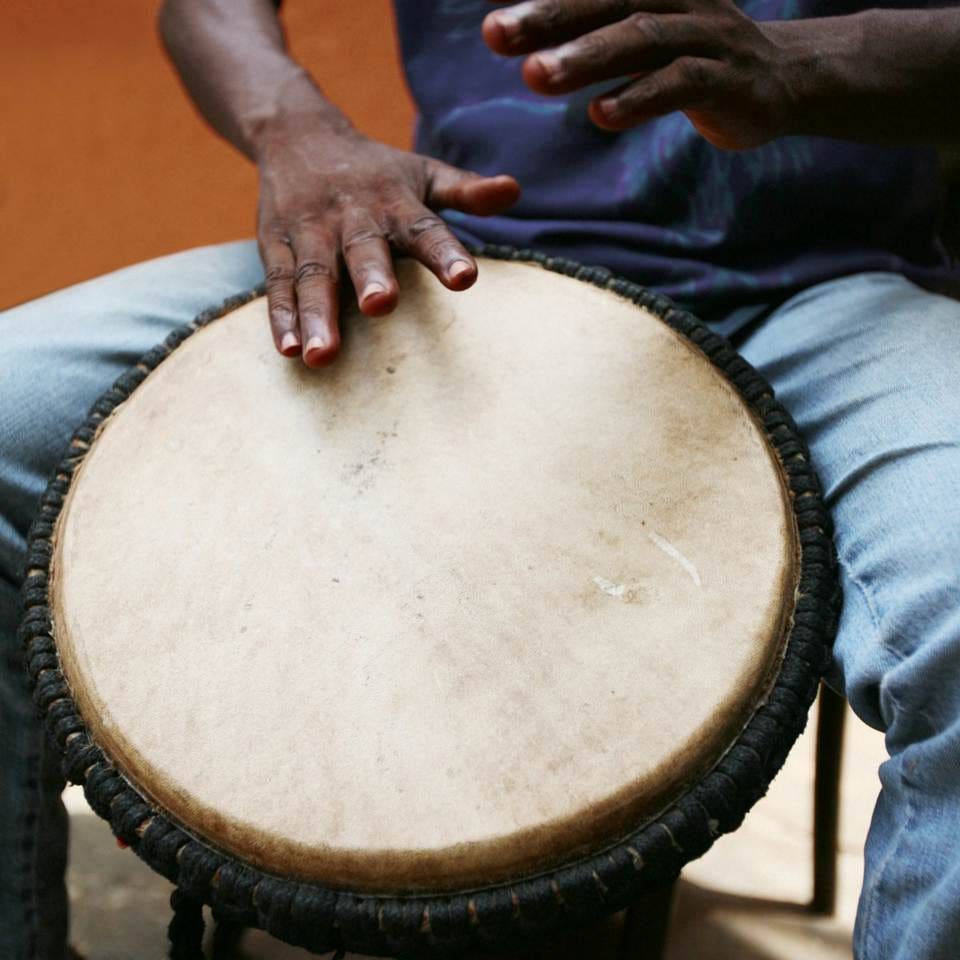
The talking drum — still sounded today to call the community to gather.
2. Re-centering accountability and obligations
Under whanaungatanga, data is understood as a living extension of whakapapa (genealogy and connection). Governed AI systems must shift from managing data points to balancing collective rights and accountabilities. There is an active obligation to ensure that the data fed into AI models does not harm, misrepresent, or exploit the communities from which it was gathered.
My Ubuntu-informed governance framework calls this - Data Points – making sure the system is built to ask the right questions and measure the right things, with harm defined by those who’ve lived it. Today, it is the vulnerable - the ones who have experienced the harm and can therefore define it accurately - who should be consulted during the design. This ensures that the issues are named correctly, the right questions are asked, and the correct data points are obtained. In short, they ensure the village - the system - never goes astray. This is how we make sure the information fed to the system, and the questions asked, allow safety, correctly see the vulnerable, respect the individual and the community they represent.
3. Long-term relational impact over short-term transactions
Western AI deployment often focuses on immediate efficiency, speed, and cost reduction. All of these are necessary and have their place. However, whanaungatanga requires assessing the long-term, intergenerational impact of an automated system on a community’s well-being. It asks governance boards to consider:
● How will this AI affect our relationship with the people we serve over the next generation?
● Does this system alienate or disconnect people, or does it foster healthier societal bonds?
● Are we designing with the people’s values, needs, and protections in place?
● What frameworks, charters, and laws are the guardrails protecting those who will use the system?
This is true accountability and responsibility to the vulnerable people we serve.
My Ubuntu-informed governance framework calls this - The Frameworks - the wisdom that holds the ethics and moral code as safety guardrails for all. Today, laws, frameworks, and charters keep the automated system’s architecture and design safe. In the Ubuntu context, it was the wise men and women of the village who held the moral north star that directed the whole community. Today, the frameworks we use within the system become these wise village elders.
4. Seeing the whole person, not the presenting problem
Under whanaungatanga, a person is never a single, separable case. They are whole only in context - their relationships, their community, their history, the web of people and circumstances that surround them. You cannot understand someone - let alone support them - by looking only at the problem they put in front of you. Yet this is exactly what automated systems do: they take the presenting issue and run in a straight line to a decision, capturing a few narrow data fields along the way and calling it the full picture.
Consider the single mother suspected of fraud because of her changing address. The system flags the changed addresses but not that she keeps moving to cheaper suburbs each time. It does not ask why she moved. It does not see that her husband died ten months ago, does not realise she now lives across town from her old community, and never connects any of this to her growing depression. It never asks about her inconsistent paycheck, whether she has a support system, whether other agencies are involved, or who depends on her. Those unasked questions were not extras - they were the rest of her story. The layers the system never reached were the very layers that would have revealed her true need. It saw a woman who had changed addresses seven times in ten months. It didn’t see the struggling widow with three young children, trying desperately to hold on.
This is the difference between an open loop and a closed one. An open loop begins and ends with the symptom. A closed loop goes all the way around the person - their relationships, their resources, their history, their dependents, the dynamic of the community they live within - and gathers the whole, nuanced picture before any decision is made. People are not static and they are not simple; a system built around human lives has to be able to see them in full. The whole person is never flattened or lumped into one homogenous category but seen as the nuanced individual they are before they are funnelled toward the specific help they need.
My Ubuntu-informed governance framework calls this - The Loop. The intention to capture the whole person, never the fragment. In the village square, when someone brought their trouble before the elders, the elders never weighed the presenting complaint alone. They considered the whole person and everything that surrounded them - their whānau, their standing, their history, the people who depended on them, the relationships that held them up. The full picture was gathered before a word of judgment was spoken, because the village understood that no one’s story can be told from a single flat situation. Everyone comes with layers. To close the loop is to refuse to flatten a person into the one question they came to ask.
5. Mitigating algorithmic bias through community context
Algorithms frequently inherit the historical and systemic biases present in societal data. Whanaungatanga addresses this by establishing checks to ensure AI interprets data within its proper cultural and community context. Under this principle, the “knowledge providers” – the people whose data trains the system - and the tech creators maintain an ongoing relationship to audit, refine, and check the AI through a built-in review cycle. The goal is to reduce data drift and prevent algorithmic discrimination, bias and misrepresentation.
My Ubuntu-informed governance framework calls this - Continuous Amplification. Within Ubuntu, the village square was always open to all; it was understood that problems never stopped. Life is always dynamic and the landscape is always changing - so periodic village meetings, where all were heard, were built into community life to accommodate this. This is old wisdom, and it is especially relevant to our lives today, and to the AI landscape. Our needs, our politics, our world are constantly changing. Continuous revision is a necessity, so the communities carrying the most harm should be periodically invited back into the room for the revisions that will inevitably be required. AI has the potential to do enormous good if calibrated right – but it can cause serious, compounding harm if audits and corrections are ignored.
Admittedly, automated decision-making within the social sector is new territory for Aotearoa, and we need to acknowledge this as we all navigate the new landscape. Some government agencies are doing more than others, and that is recognised and acknowledged – especially since these governance guidelines are voluntary rather than enforced. But we would not be doing our job as community advocates if we stayed silent in the face of continuing and compounding harm.
Whanaungatanga is a sound base for agencies to check how well they are doing — an effective internal scale for measuring whether they are providing the minimum of care within AI governance.
As I watch the growing community of advocates for the vulnerable gather around this issue, I smile. It reminds me of a proverb my grandmother loved to say:
“Kamu kamu gwe muganda” – which literally translates as: “One by one makes a bundle.”
The deeper meaning is although one reed is weak, a bundle of reeds is strong enough to hold up a large structure. It is a reminder that big challenges are taken on step by step, and that through collaboration and community effort, even the most impossible tasks become manageable. All your voices are needed, because together we can create change.
Ultimately, the path to truly responsible AI governance in Aotearoa New Zealand asks for an infusion of indigenous wisdom into a largely Western, individualist legal tradition. When Ubuntu and whanaungatanga meet – two relational worldviews reaching the same truth from different shores – are operationalized through Māori Data Sovereignty principles, their meeting offers a robust architecture for a healthier digital future. The lessons of the village square show that algorithmic harms are not isolated code glitches or mere financial liabilities. They are the digital equivalent of the greedy brothers’ actions — direct tears in the communal fabric that threaten collective well-being.
This relational model is realised by adopting all three of the shifts named at the start:
I. First, the state can restore the open-air transparency of the village square and the marae ātea by opening corporate “black boxes” and replacing them with accessible, transparent digital palavers.
II. Second, the Crown can move beyond consultation to genuine consensus-driven co-design, giving affected communities real authority over the systems that shape their lives.
III. Finally, the system can move beyond state-centric ownership of outcomes toward true Data Sovereignty, asking tech developers to carry genuine accountability and to return control of digital solutions to the communities affected.
In an era where our social welfare is increasingly shaped by automated decision-making, anchoring policy in indigenous wisdom protects us as a collective. It is the preservation of our humanity and the protection of communal mana – this foundation should always guide the systems we create to serve the vulnerable among us.
Denise Barlow-Byarugaba is a Human Systems specialist and the founder of The Room Institute. She practices through the lens of Ubuntu-informed AI governance - a framework that redesigns systems that make decisions about people, from policy to automated decisions, with the communities that carry the cost of our failures. She draws on almost 30 years in community development, walking alongside Māori, Pasifika, and CALD communities across Aotearoa and East Africa. She has worked on both sides of the glass: the frontline, where she has seen what poorly designed systems do to people, and inside the build, where she has seen how they are made. She partners with government agencies and NGOs to redesign those systems so that the vulnerable are protected, as welfare policies and emerging technologies land in real lives.