

This was different.
Jean-Paul felt it even before they attended the event. The email had come in two languages – English and French – and then again as a phone call from someone the family trusted, not from an address that began with “no‑reply”.
The letter had said there would be childcare, and that the meeting would finish in time for school pickup. It had requested their attendance politely and explained that this design workshop was endeavoring to do things differently. There were travel vouchers offered, and the invitation had arrived a month before the date, not two weeks before. The letter had provided options for interpreters for anyone not comfortable in English, so Jean-Paul and Marie had asked for a French interpreter.
From the moment they walked in, Jean-Paul and Marie could see this workshop was not like the others they had previously attended.
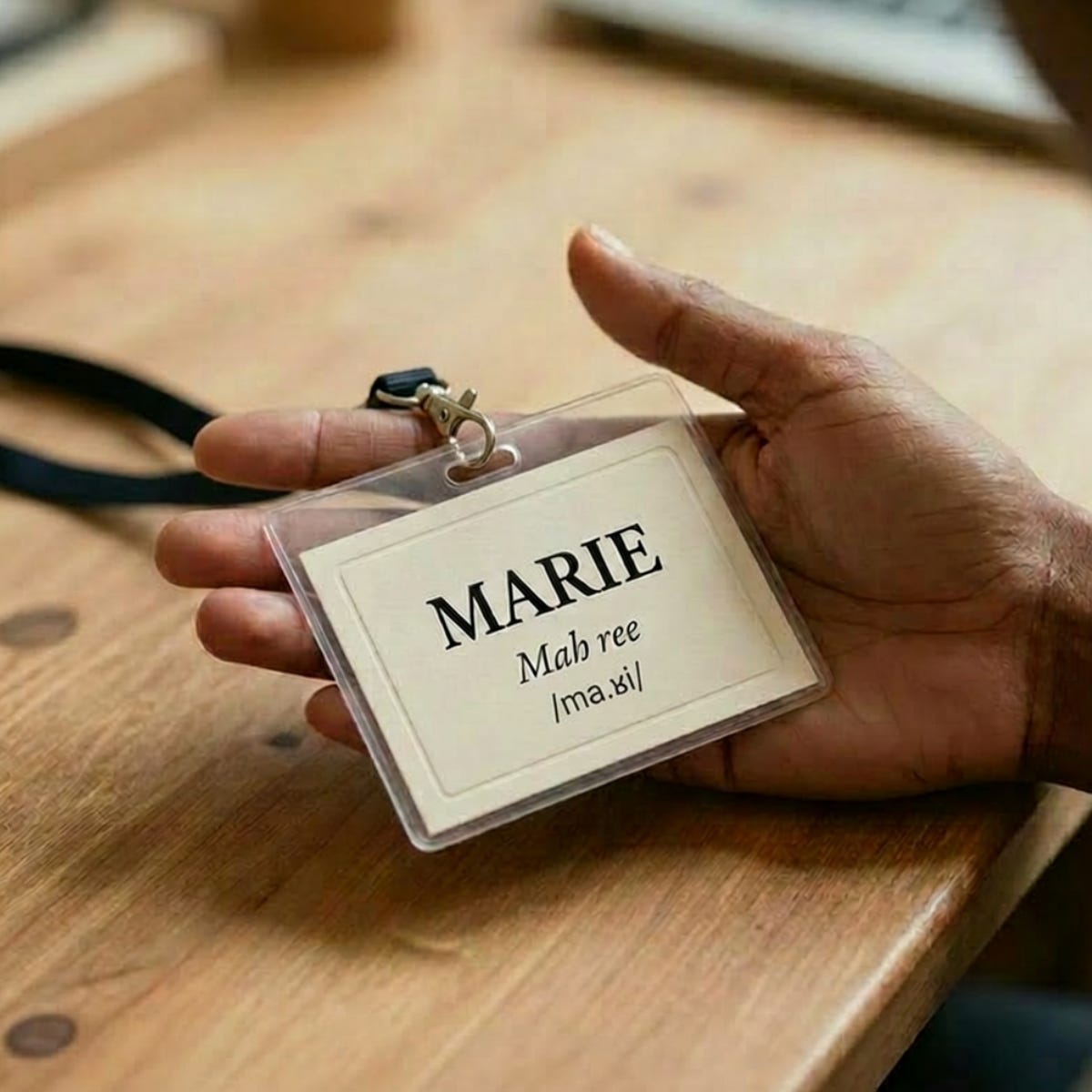
Marie noticed the little things first. On the sign‑in table, the lanyards with their names clearly printed. Her name card said “MARIE”, and underneath, in smaller letters, her name written two ways:
Mah‑ree
/ma.ʁi/
It was a small thing, but it mattered to her. She had missed people saying her name right- the French way.
Next to the lanyards, someone had put out small flags and stickers that quietly said welcome. The ones closest to her read: “Kia ora”, “Jambo”, “Bienvenue”, “مرحبا”, “Boyeyi malamu” … she could not see the rest, but when she saw the Lingala welcome, she felt the tension start to leave her body.
A kind woman with a Red Cross lanyard bent down to four‑year‑old Chantal’s level and explained, slowly and with a smile and gestures, that there were toys and crayons in the next room, and that her parents would be just through the wall if she needed them. Giggling, Chantal left holding the woman’s hand, without a backward glance. The woman winked at Marie reassuringly as she left with her daughter.
The smell from the back of the room was familiar and new at the same time. Coffee, yes, but also mint tea, a variety of fruit, flatbread, samosas, puff-puff balls, and was that mikate?! Smells that reminded Marie of home. The food on the long table was clearly labelled with little cards: “vegan”, “vegetarian”, “gluten-free”. There was a table set aside labelled “Halal - no pork”.
“How considerate for our Muslim friends,” she thought, as her shoulders dropped a fraction more.
They had attended a government workshop before, and the title on that email had been impressive too. “Consultation on the National Refugee Strategy”, it had said. They had gone, because they had been told their voices mattered. In that room, the chairs had faced a projector screen. The plan had already been on the slides. Their comments had been requested in the last twenty minutes, after the PowerPoint presentation.
That time their job had been to “share perspectives”. They talked about childcare, learning English, qualifications that vanished on paper. People from the agency nodded and said they had captured their contributions. They had believed them, but months later, nothing in their lives felt different.
This room was set up differently from the last one. The chairs were in loose circles around the tables. There was no projector screen. On the walls, there were only large sheets of paper and clean, empty space.
Jean-Paul recognized a few faces as they found their seats. The older Sudanese man from the mosque. A young Syrian nurse he knew from the bus stop. A grandmother from Myanmar with her daughter beside her. A tall Afghan builder who always wore a hi‑vis jacket, but not today. An older Somali man he knew by sight, who had been in the country longer than any of them, he sat very straight with his hands folded, watching the officials more than the room. There were others he did not recognize. He nodded and smiled at the faces he knew.
The officials all wore branded clear name tags making it easy to tell them apart. A man in jeans with a laptop under his arm, looked like he might be “the computer person”. A woman from Palmerston North City Council he had once seen speaking at the library. Someone from Work and Income. A young lady from the Te Whatu Ora public health team and a gentleman from Community Law. Two officials from Immigration New Zealand, and a lady from Māngere Refugee Resettlement Centre who had travelled to attend. Yet they all sat around the circle, mixing with the group.
“This is the first time,” Jean-Paul thought, “that all the agencies with pieces of our story have been put in one room.”
Marie sat and ran her fingers along the nametag before putting it on.
She sighed. Last time, the invitation had felt like a summons – here she felt respected.
She turned to her husband and smiled. “This feels different, Jean-Paul. They see us. Look at how they thought about every individual person’s needs.”
He smiled back. “It looks like they finally realize we are not all the same.”
The interpreters took their places, introducing themselves one by one, then sitting directly behind the people who needed them.
When everyone was settled, a woman stood up, not behind a lectern but beside the seated group. She began with a mihi, greeting mana whenua first, then the communities in the room, then the agencies. She introduced herself by her first name – Patricia – and her whakapapa before she said her job title. Then she spoke slowly, in English, with pauses for the interpreters to follow:
“This is a government design workshop. We are here today because we realize you should have been here before anything was built – we want to correct this. So today, there is no finished plan on the wall. You are here to help us redesign service delivery for future refugees. What we design in the next months will shape how future families like yours meet this system – the practical services, and also the automated parts a computer helps decide. That is why your voice is so important.”
Jean-Paul felt Marie’s hand tighten around his under the table.
“Last time, they asked us what we thought of their plans,” she whispered. “This time, it sounds like they are asking what our lives are like, before there is a plan.”
At the next table, the man with the laptop – the one Jean-Paul had guessed was “the computer person” – nodded along as Patricia spoke. He did not open his device. After Patricia sat down, he stood up. Looking slowly around the room, he explained why he was there.
“Before, people in offices wrote the rules that decide who gets what help, and then asked you what you thought,” he said, pausing for the interpreters. “Today we are starting the other way round. We want to understand your lives first. The tools – including the computer systems that process your benefit decisions – will be built from this.”
He added that they would also be speaking with other groups – Māori, Pasifika, CALD communities, disabled people, and other vulnerable communities – so that their input would be captured in the revision of the system.
Jean-Paul glanced at Marie. “They are talking about the automated decision‑making program that the government is expanding,” he murmured. “We get to help improve the system for others.”
One of the officials from Immigration New Zealand stood up to speak. He explained that the goal for all officials attending from the different agencies was to listen carefully and capture the opinions, ideas, and issues raised in the room. Their task, he said, was to convert these into real changes that would benefit future refugees.
Jean-Paul smiled softly, finally understanding the intention in the room. It is not that Aotearoa had done nothing for them. When they arrived from the Democratic Republic of Congo, Jean-Paul and Marie felt safe, for the first time in years.
They had the skills New Zealand had a real shortage of. Jean-Paul was a psychiatrist, trained at the CNPP - the neuropsychiatric center at the University of Kinshasa - and years of experience in a busy city practice. Marie was a qualified veterinarian who had worked with livestock. Unfortunately, this did not translate into employment. Their working language had been French, with Lingala at home. English was never a language they had needed to speak. When they stepped off the plane in Auckland, every word in English was new.
At Māngere Refugee Resettlement Centre, staff and volunteers helped them through those first weeks: health checks, school enrolments, bus cards, GP registration, tenancy and bond rules, what to do in an emergency. Interpreters stood beside them in the rooms that mattered. They were housed, clothed, registered, talked through the basics of life in Aotearoa. It felt, genuinely, like being held.
When they moved on to Palmerston North, the Red Cross team and a small Congolese community picked up the thread. People in the community helped explain letters and school notices. Volunteers showed them where to buy familiar food, which buses to take, how to call the clinic. For the first months in Aotearoa, there was almost always someone they could call who understood both their languages and their new city. It was still hard, but they did not feel alone.
The safety was real. So was the gratitude. But underneath it, the obstacles were also real.
To work again as a doctor in New Zealand, Jean-Paul had learned, he would need registration with the Medical Council of New Zealand. That meant proving his qualifications and experience, passing assessments, and, crucially, showing a high level of English through an approved test before he could even enter some of the registration pathways for international medical graduates. The forms were long and intricate, full of phrases that assumed not just conversational English but exam English. He spent many evenings at the kitchen table with a French-English dictionary and his old certificates, trying to make the paperwork match the person - until he had given up in frustration.
Interestingly, psychiatry is one of the most stretched specialties in Aotearoa - about a fifth of senior posts vacant, a quarter in the Central Region where they lived, and roughly three in every five psychiatrists already working here had, like him, trained overseas. The country was short of the skill that Jean-Paul had, but it still locked him out of the practice.
A trained volunteer came once every weekend to teach both of them English. It was a genuine kindness because it helped them integrate into Kiwi life and Jean-Paul could finally chat to Chantal’s teacher. Unfortunately, no volunteer could carry him from “Kiwi English for daily life” to the exam level 7 English the Medical Council required. The help that reached his door was not the help that would open the professional one.
Marie’s path back to veterinary work was no easier. To work as a vet here, Marie’s Lubumbashi degree had to be assessed because it wasn’t on the recognized list. That meant sitting the two-part Australasian Veterinary Examination, a written paper and then a clinical exam run through Massey, before she could register with the Veterinary Council. Passing the first part would let her work only under supervision - but the very shortage that made the country want her meant the clinics had no one spare to supervise her.
Every step assumed a level of technical English she did not have yet. The registration requirements talked in a language she was still learning to navigate. The applications, the guidance notes, the exams themselves – assumed a level 7 technical English. New Zealand was advertising for livestock vets, had an experienced one right here, but she too could not practice. Even the streamlined Green List pathway, built to fly vets in from overseas, was closed to her: it required her to already be registered. So, another door closed.
For both of them, the English requirement was not just social; it was formal, written into the rules. The pathways back to medicine and veterinary practice were real, but they were also long, exam‑heavy, and built for people who started with strong English, not for people starting from zero.
At first, Marie had tried to find her way back into practice. If she could get to English classes, then to the assessments, maybe one day she could get back to her beloved profession. But Chantal was four and got only 20 free early-childhood hours a week. To put her in care any longer - for the number of hours needed to attend a course that would upgrade her English - Marie needed the childcare subsidy. And to get more than a handful of subsidized hours, the rules asked her to already be working or studying. To study, she needed the childcare. To get the childcare, she needed to already be studying. Marie was caught in a childcare-subsidy catch-22.
In the meantime, they needed to pay rent, to buy food and take care of their little girl.
So, when a supermarket job opened up, Marie did the only sensible thing the rules left her room to do: she took work that fit inside Chantal’s twenty free hours, stacking shelves while her daughter was at daycare and collecting her when the funded hours ran out. Now she was learning product codes instead of disease surveillance updates.
They took survival jobs - the only jobs they could get with their limited English. They did not resent the work. The income was welcome. The co‑workers were often kind. But every shift underlined the same quiet message: they both had the skills New Zealand desperately needed and yet somehow the jobs were out of their reach.
Jean-Paul was employed at the Warehouse doing manual labour – lifting, stacking, cleaning – work he did with care, but which had nothing to do with the years he had spent diagnosing and treating patients. Eventually he had to take on a second job, driving for Uber, to make ends meet.
Some nights, after the last fare, Jean-Paul caught himself noticing the signs he had spent a career helping others name - the flatness, the thinning sleep, the way he had started leaving calls from home unanswered. He knew exactly what to call it. He also knew that in a country this short of psychiatrists, there was nowhere to send himself. He also knew he could not afford the time off.
Sometimes Palmerston North made the loneliness easier to bear. There were other Congolese families who understood their jokes and their silences. The community spoke a language they knew. When Jean-Paul needed to talk about DRC politics, or Marie needed to reminisce about home recipes, there was usually someone who understood without explanation.
But some absences no community could fill. Marie’s mother was still in Kinshasa - a voice on a line that dropped out mid-sentence, a grandmother who missed watching her grand-daughter growing every day. And Jean-Paul carried his twin brother, the one who shared his face, still back there, still unsafe. A part of every fare he drove was promised before he earned it, sent back across the world. They could be surrounded by their own people here and still feel split in half, the other half a continent away.
A year on, the doors had still not opened. New Zealand’s only veterinary school was a few kilometers from their flat; Marie knew she did not have the papers they needed to see her skill. On the job sites, it was true: there were listings for psychiatrists and vets everywhere. However, the doors stayed shut. Some closed early, asking for New Zealand experience and full registration. Others called them in for interviews, but although their skills matched the jobs advertised, the interviews expected effortless English, and the unspoken bias was that poor English meant poor skill.
With time, something else changed. The dedicated Red Cross support - the guidance of the caseworker who not only spoke French and Lingala but also helped them navigate their new home - had to stop. The support had always been time limited. It ran its course over the first eighteen months, thinning as it went, and then it ended. Jean-Paul and Marie were in the mainstream system now, relying on MSD for income support and job-seeking help, like everyone else. The trouble was that “like everyone else” assumed a footing they did not have.
MSD saw them as work‑ready, sometimes even “over‑qualified”, for the kinds of low‑wage jobs advertised on its website – and simultaneously invisible for the roles that matched their training. Automated decision‑making systems helped process their payments and reapplications, but those systems did not ask – and could not know – that Jean-Paul had once sat with patients in crisis, or that Marie understood biosecurity risks better than most people in Aotearoa.
New Zealand offered theoretical opportunities but not access. The vacancies were there. The pathways were there. The rules, exams, and English thresholds that sat between them and those opportunities were there too – but there was a disconnect between the promise and the lived reality.
While the support lasted, when a confusing letter arrived, there had been someone to sit at the table and read it line by line. The letters still came - the same official English, the same deadline buried in the third paragraph - but now they were met with dread and a French-to-English dictionary. Their English had come a long way in their time here, but they still struggled.
That was the shape of the vacuum they carried into this new workshop: safe, but under‑used; grateful, but tired; highly skilled in exactly the areas New Zealand said it needed, yet working in jobs that did not touch those skills; shifted from a world of named supporters into a world of automated decisions and generic categories.
Patricia the workshop guide stood up again.
“Today,” she said, “we are not asking you to comment on a finished strategy. We are asking you to help shape the rules before they are written into forms, letters, or computer systems. The letters that arrive in your mailbox or as decisions that affects your life – we want to understand whether they need to be redesigned to improve the outcomes. Your life stories are the starting point.”
The interpreters moved a beat behind her. Heads around the room nodded at slightly different moments, like a soft echo.
She glanced around the circle, checking that everyone had understood and that no one had been left behind.
Marie felt something unfamiliar: No one was rushing them through a list of bullet points. No one had said, “We only have ten minutes for this part.” Here they were all listening for their answers.
Jean-Paul listened to the words “…before they are written into forms” and remembered that letter that had arrived in complicated English, with a deadline hidden in the third paragraph. He wondered, for the first time, if he might suggest that all important government letters be made available in languages other than English, some did but he wished more could. Maybe, he thought, they could even use safe translation tools to make that possible. He knew that Canada, Singapore and the United Kingdom were using this technology.
Patricia walked over to one of the blank sheets taped to the wall.
“In a moment,” she said, “we are going to start with your stories. Not ‘feedback’, not ‘comments’ – your stories of what happens when you meet this system: at Work and Income, at the hospital, at school, with Immigration. We will listen first. Then the agencies here will ask: if we considered your experiences, what would we need to change, and what would we keep?”
She put the marker down on the table instead of writing anything yet. The page stayed empty, waiting.
The process was explained slowly. First, Patricia said, each person would have time on their own to write or dictate their answers to a small set of questions, with their interpreters and staff on hand to help. Then they would talk in small groups, to see what was the same and what was different in their stories. Only after that would anything go up on the walls.
“Everyone here,” she said, “has the right to be heard in their own words. So, we will capture your words first, before we try to turn them into themes.”
Staff moved quietly around the room, handing each person a sheet with four questions printed on it:
What is working for you — in health, housing, work, education, community?
What is not working? (What things are affecting the quality of your life)
What did we miss?
What should change before this goes wider?
Each question was written in clear English, and the interpreters read them out slowly in other languages. Where people preferred to speak rather than write, interpreters wrote their answers down exactly as they said them, in their own words, checking back to make sure nothing had been lost.
Patricia walked slowly around the circle, acknowledging everyone, grateful for the variety of stories in the room. A Syrian man who had spent months trying to get his overseas social work qualifications recognized. A young nurse from Burundi working nights in aged care while she chased qualifications that would be recognized here. A Burmese young man who did most of the talking for his family at the clinic. A former refugee youth worker who knew the school system from both sides. Different ages, different professions, different countries – each writing their stories on the clipboards they had been given.
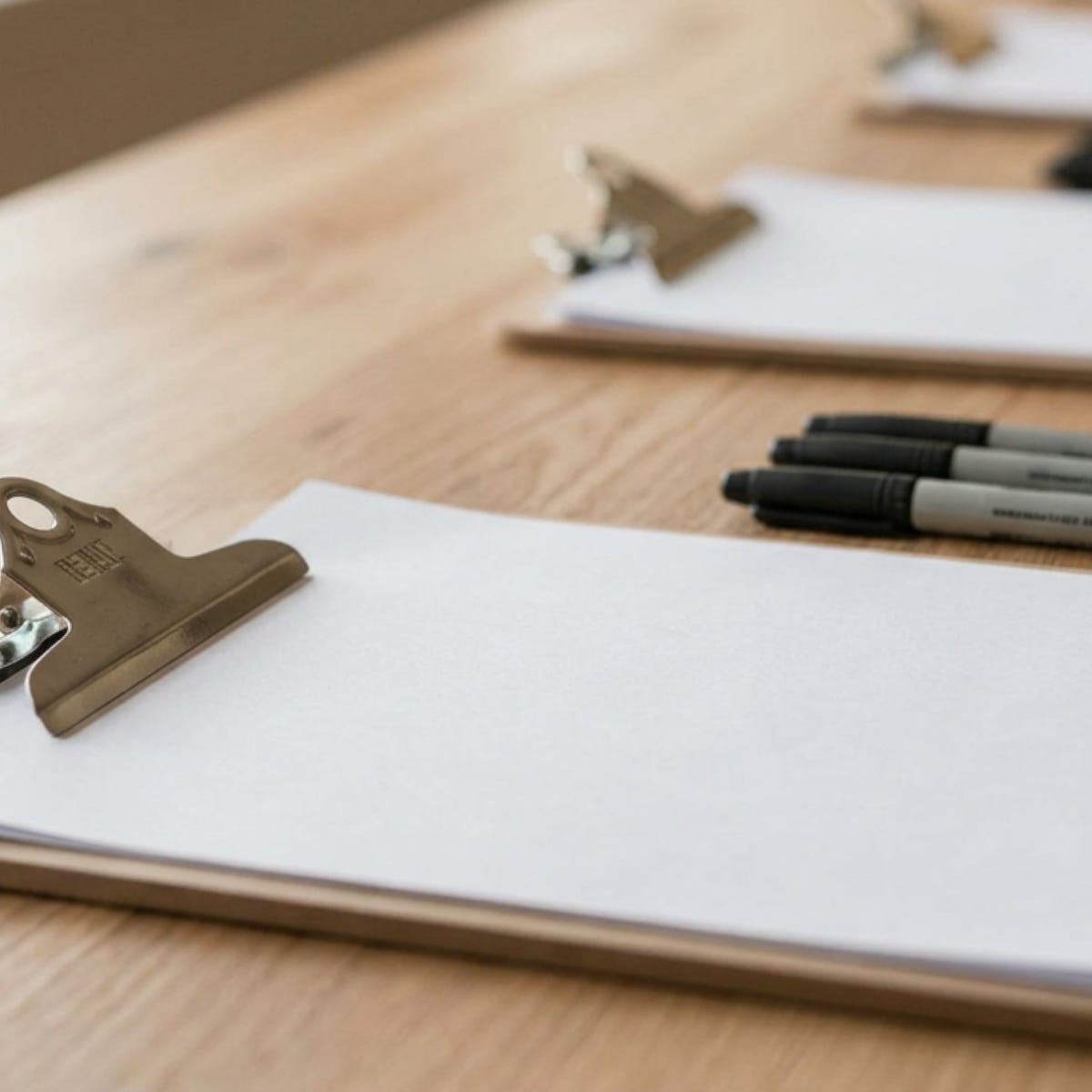
In the corner opposite Jean-Paul sat a dignified older Somali man, he did not pick up the marker. He looked at Patricia and spoke through his interpreter. “I have sat in rooms like this before,” he said. “Good rooms. Kind people. We talked. They wrote our words down.” He let the words rest. “Then nothing changed.” He folded his hands again. “I will tell you about my life. But forgive me if I do not clap yet. I have clapped before.” Patricia nodded at his words with respect. No one rushed to reassure him. His interpreter simply wrote down what he had said, word for word, and thanked him.
Marie watched the care being taken. No one was paraphrasing their words into “key challenges” or “themes” yet. When she said, “The letters from the government make me feel stupid, even when I know I am not,” the facilitator wrote exactly that on the page.
Jean-Paul’s first instinct was to answer: “Warehouse laborer / Uber driver (two jobs).” For months, that was the version of himself the system seemed able to recognize. Then he saw the next line: “What work did you do before you came to New Zealand?” For a moment his eyes misted.
“Doctor,” he said softly to his interpreter, then asked him to add, “Psychiatrist.”
Beside him, Marie wrote “veterinarian” and after a pause, explained to her interpreter: “I worked on animal disease and food safety – stopping sickness before it reached people.”
The interpreter paused at Marie’s words. For the first time, he seemed to grasp the full significance of Marie’s expertise: not simply caring for animals, but helping stop sickness before it crossed into homes, markets, and communities. In a country with persistent veterinary shortages and strong reliance on biosecurity, that kind of skill was not marginal; it was urgently relevant.
At the far side of the room, the man in jeans with the laptop – the engineer – sat with his own clipboard in front of him. He was not typing. He was writing, in the same thick black marker as everyone else. When one of the participants looked over and asked what he was doing, he smiled and said, “I am learning how you experience the system - what it looks like now from your side - and what you would prefer it to be instead, before I touch a keyboard.”
When the other near-by participants looked up at his comment in surprise, he shrugged. “Usually, they hand me the rules and I build them. This time I get to listen to the people I actually build these systems for.”
The room settled into a busy buzz. The staff were not just collecting stories; they were listening for definitions. For how harm sounded in the mouths of the people who felt it. For what dignity looked like in a Work and Income office. For which parts of the hospital journey made people feel safe, and which parts made them feel small.
As Jean-Paul went to re-fill his mint tea at the tea urn, he caught the edge of a conversation that wasn’t meant for him. Two of the officials talking to each other, paper cups in hand. “It’s the right way to do it,” one was saying, quietly. The other frowned “But think about it, we have to run this again in Auckland, Christchurch, then Wellington, the time and money this takes is just….”
Jean-Paul didn’t wait to hear the rest. He didn’t want the doubt in the sentence to settle in his body. Thankfully, his basic English would not have allowed deeper comprehension anyway.
When the individual pages were complete, they turned to small-group conversation. At each table, Patricia asked the same four questions again, out loud this time:
What is working?
What is not?
What did we miss?
What should change before this goes wider?
People pointed to their own sheets and to each other’s. The Burmese young man spoke about how visual health leaflets and pictograms had helped his family. The Syrian young girl talked about her hotel manager who changed the roster so she could get to her English classes on time. Jean-Paul talked about the English proficiency required to take the New Zealand Registration Examination (NZREX) needed as an internationally trained doctor. He explained that this sat between his experience and any chance of practicing again. Marie talked about reading the veterinary registration guidance and feeling as if she were standing at the bottom of a mountain she could not climb.
The facilitators did not rush them. They repeated back what they had heard – not in policy language, but in the same words people had used – and checked if they had it right. When someone suggested a change, it went down on paper with their name beside it, not folded into a vague “community feedback” box. The respect and recognition for their lived experiences were obvious.
Before they closed the workshop, Patricia made one more promise. In six months, she said, they would be called back. Each agency returning with reports on what they had tried to change, everyone in the room would be invited to say what had worked, what had not, and what still needed to happen. This was not a one-off consultation. This was the beginning of a relationship.
Jean-Paul looked at the older Somali man across the room. His dignified face did not give much away, but he had watched Patricia’s face as she spoke. When she was done, the old man held her gaze a moment longer than everyone else – and gave her one slow nod. A man marking a date he intended to keep. In six months, that look said, I will be here. And I will see for myself.
That evening, Jean-Paul and Marie did not leave with a strategy document under their arm. But with the unfamiliar, fragile feeling that someone had finally written their experience into a blueprint.
Now, I have sat in both kinds of room: the one where the plan is already on the slides, and the one that opens with a blank wall and a question. The difference is not comfort, or kindness, or good intentions. It is the difference between “Do you agree?” and “How is it for you?“ The difference between asking people to approve a blueprint and trusting them to draw one. Between being a subject of the system and an author of it. Aotearoa is at the cross-roads – it is time to choose which room we build for the vulnerable among us.
Jean-Paul and Marie are invented. The struggles they live with are not. On 1 July, New Zealand widens automated decision-making across more of its welfare system. Most of the families those rules will affect were never in the room where the rules were written. The only question now is whether we correct the room before expanding the system even further - or after the harm is done.
Denise Barlow-Byarugaba is a Human Systems specialist and the founder of The Room Institute. She practices through the lens of Ubuntu-informed AI governance - a framework that redesigns systems that make decisions about people, from policy to automated decisions, with the communities that carry the cost of our failures. She draws on almost 30 years in community development, walking alongside Māori, Pasifika, and CALD communities across Aotearoa and East Africa. She has worked on both sides of the glass: the frontline, where she has seen what poorly designed systems do to people, and inside the build, where she has seen how they are made. She partners with government agencies and NGOs to redesign those systems so that the vulnerable are protected, as welfare policies and emerging technologies land in real lives.