

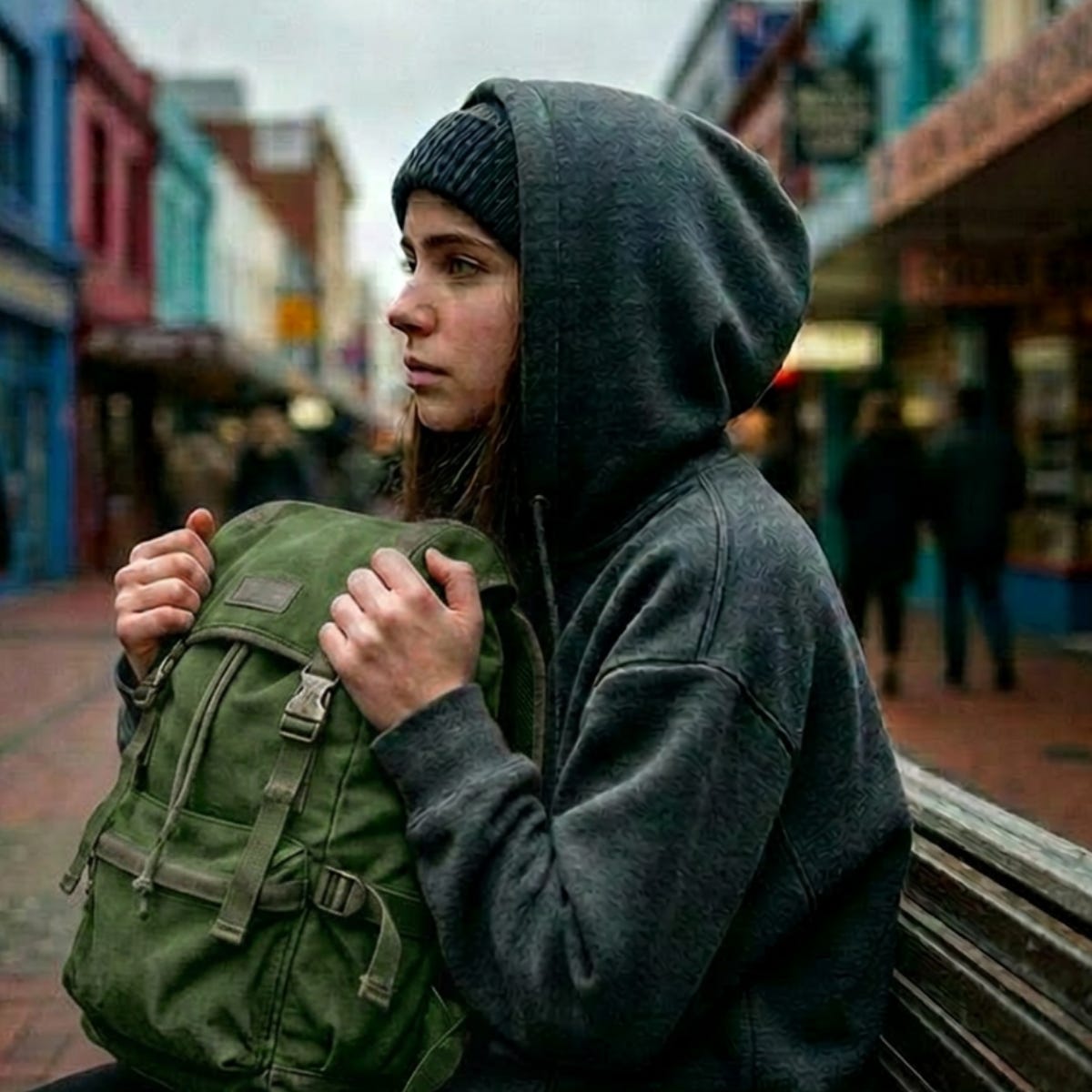
Image was created with Canva AI
Most people in Wellington walk past her. Not because they are cruel, but because they have to keep moving. It is cold, the southerly cuts down the street, and there are always emails to answer, buses to catch, children to pick up.
Rachel looks like many of the young women who gather on Cuba Street. Beanie, hoodie, backpack. At a glance, she could be waiting for a friend. If you look twice, you see the difference. The way she watches every passer-by without really looking at anyone. The way she holds her bag as if it is the only proof she owns anything at all.
Rachel is only twenty-one. She is alone. And this winter, she is sleeping on the streets.
There is kindness in her day. A soup kitchen, a social supermarket and free store gave her the dignity of choices, a drop-in that provided free health care and basic needs and another that provided a place to clean your laundry and get a warm shower. On paper, there is a lot of help. Someone kind will check that she has a warm blanket when the night is particularly bitter. In that sense, the city has not abandoned her.
But the help that would actually get her off the street – emergency housing, stable income, a door she can close and lock – sits behind processes she struggles to navigate.
Every process Rachel needs to walk through assumes a version of her that does not exist.
The forms assume she has a fixed address to write down. The appointments assume she can keep track of dates and times when she has nowhere safe to keep a phone charged and no quiet place to think. The interviews assume she can sit across from a stranger and tell her story calmly without her throat closing up from shame.
They assume she knows and understands these processes exist in the first place.
The agencies ask the same question: “Is this person eligible?” Eligibility is a question about her. It puts her on trial. Does she qualify? Does she have the right documents? Did she attend the appointment? Did she cause her current situation? How long has she been without employment? Is this a reflection on her character? Every one of these questions is a test she must pass. Each one feels like a judgement. She is expected to answer them in her traumatised hypervigilant state. How could she when she can’t think beyond where she is going to sleep tonight?
Trauma takes the part of you that plans and trusts and tells your story to a stranger at a counter. That part goes first. Addiction, for those who carry it, is rarely the start of the trouble; it is the thing that quiets the noise in your head. So, the cruelty is built right into the shape of the system: the very conditions that most qualify a person for help - the fear, the disorganisation, the inability to hold a thread - are the same conditions that disqualify her from operating the help. The more she needs it, the less she qualifies for the help. The door stays open, and those behind the door say she walked past it, and choose not to engage. They record this as her choice.
The truth is, Rachel was not an addict when she arrived on the street. The addiction came later, as an adaptation, not a cause. It came with the wet clothes, the constant stress and the sleepless nights. It came with the constant calculations of where to sit so she is visible enough to be safe but invisible enough not to be moved on. It came with the need to blunt the cold and soften the edges of the fear.
People see the substance use and assume it is the reason she is here. She knows it is one of the only ways she is managing to stay here at all.
Yes, we do offer help. But let us look closely at what we offer.
The truth is we offer fragments of help, kept in separate buildings, held by separate agencies that do not speak to one another. Housing is one ministry. Income is another. Mental health is a third. Addiction, a fourth. Refugee resettlement, a fifth — each with its own building, its own criteria, its own waitlist, its own version of the eligible person it is waiting for.
So Rachel is not facing one door. She is standing at the mouth of a corridor of them, and each one opens onto a different office that knows only its own slice of her. To get what she needs she must walk to many offices, sit in front of different case workers, fill in different forms, tell her story again at every desk, become a slightly different applicant each time, and carry the information from one application to the next herself. We are asking her to be the connecting web between agencies that will not connect - to hold the whole picture together inside her own exhausted mind. A system operating in silos that has never bothered to hold together on its own.
Yes, it is easy to say that Wellington has services. Work and Income. Housing support. Housing First and outreach teams. Soup kitchens, day centres, shelters, drop-ins. The doors do exist.
From where Rachel is sitting, the question sounds different: do these services reach her? – in this state, with this brain and this body in winter – or do they wait for her to reach them?
Right now, the system still asks the same question over and over: “Is this person eligible?” Rachel is living proof that it is the wrong question. She will still be sitting on the bench on Cuba street next week.
Asking the question “Is this person eligible?” sounds responsible. It sounds like careful stewardship of scarce resources. But it is the wrong question.
The better question - the only one that would actually find the people who truly need our help - is a question about us: Can she reach our service?
Let’s consider: There is emergency housing, in theory, for people with nowhere safe to sleep. There is Work and Income emergency housing process with its forms, assessments, and waitlists. There is Housing First that requires she prove that she has been on the streets long-term before she qualifies, Wellington City Mission that requires documentation of alternative avenues, Kāinga Ora’s long and involved application process that relies on MSD for its referrals. I do notice the good mahi and the reprieve offered by these agencies, but I want us to acknowledge the hurdles that an already stressed mind would experience.
Tragically most of these services are not only oversubscribed, they also only offer transitional housing - a welcome relief, but not a permanent solution. Atareira, Hutt Valley Community Housing, Tuatahi Centre, and Wellington Homeless Women’s Trust, are some of the agencies that offer this temporary reprieve.
Credit needs to be given to the outreach workers whose job is to find people on the street and walk alongside them for as long as it takes. There are community agencies like Downtown Community Ministry, the Soup Kitchen, the night shelters, women’s refuges, and churches that open their doors when everyone else has gone home.
Taken together, they look like a well-coordinated network, providing a safety net to catch those who slip through – and most times they do. However, the danger is that we could walk away feeling - “we are doing all we can”.
The numbers tell a harder story.
The latest national homelessness insights report, produced by Te Tūāpapa Kura Kāinga – Ministry of Housing and Urban Development, shows tens of thousands of people across Aotearoa living in severe housing deprivation – including people in cars, garages, boarding houses, and emergency accommodation. The official social housing register still sits at 19,704 applicants waiting for a public house as of 31st March 2026.
In Wellington, frontline services like the Soup Kitchen and Orange Sky report more people turning up for kai, showers, and support, not fewer, and warn that homelessness is rising faster than the city is growing. Downtown Community Ministry’s own count of rough sleepers climbed from 114 to 141 between 2024 and 2025, a 25% increase. So, evidence suggests that the rough sleeping number keeps climbing every day. After falling since 2023, the social housing register is climbing again - up 2.1% in the past year.
At the same time, access to emergency help is getting tighter. After changes to emergency housing rules in 2024, people can be declined if officials judge that they “caused or contributed” to their own need. One analysis found that decline rates for emergency housing applications skyrocketed from just over 3% in 2023 to nearly 34% - more than one in three - by 2025. Advocates and food banks report a similar pattern in hardship support: more people asking for help, more food grant applications turned down. This means that the vulnerable already fear a real possibility of a decline even before they apply.
So yes, the services exist. The system can show you the doors. It points to a register that has fallen from over 25,000 since 2023, as progress - but its own officials warn that the number drops not because the need was met, but because people give up applying. On paper, some indicators are even improving, the government declares its 75% reduction target met five years ahead of schedule as success. It can point to increases in social housing supply and call that progress.
However, for Rachel on the bench on Cuba street, the experience is different. She sees a list of phone numbers and addresses she cannot hold in her head. She sees offices that want more answers than she can give. She sees documentation that will be requested and forms that she has to complete. She sees waiting rooms where she is not sure which version of her story is safe to tell. It’s the survival instinct; she always feels it in her body – so what she tells a government agency is often different from what she can tell an outreach worker.
Rachel hears the government is building more homes for people like her, but the truth is – the hurdles around them are too high for her to climb over. Her heart carries one grateful truth – “Thank God for outreach workers!” - they are the heroes in her story. She sees them doing their best – but with more people to reach than hours in the day, she knows they just touch the tip of the iceberg.
But they are the ones who still respect her mana, who refuse to let her disappear. Instead of waiting behind a desk for her to arrive, they go to her. DCM’s outreach team, Toro Atu, walks the streets to meet people who are rough sleeping where they are, treating that first contact not as an assessment but as the beginning of a relationship. Through the Aro Mai Housing First collaboration, they work to move people into a permanent home first, then wrap support around them so the tenancy holds - and along the way they sit with her to get her ID, untangle her entitlements, and complete the forms she cannot face alone. They navigate the corridor on her behalf, rather than asking her exhausted mind to navigate it for them.
Kaupapa Māori providers have held this for decades. He Herenga Kura has walked alongside the vulnerable for over fifty years, grounded in Manaakitanga (dignity and well-being), Kotahitanga (collective responsibility), Rangatiratanga (autonomy), and Whanaungatanga (strengthening relationships), with housing and support designed specifically for people like her, offered to Māori and non-Māori alike. Their model does not begin by asking whether she qualifies. It begins by asking what she needs to thrive, and it holds the whole of her - her wellbeing, her connections, her future - rather than a single slice. This is what mana-enhancing practice means: help that restores dignity instead of demanding she earn it.
Other agencies are the exact opposite. They split her needs and never see her as whole. Each agency can point to the piece it is responsible for; her accommodation, her health, her budget, her employment. None of them is responsible for whether the whole picture adds up to safety for her. No one holds the whole of her. At a distance, it is easy to believe the system is neutral. A form here, a checklist there, a series of criteria applied the same way to everyone. This is what it looks like when one’s life is handled by silos. On paper, it looks fair, it sounds reasonable and responsible. Rachel seems to be surrounded by services that solve her problems.
But the system was not built for her. It was built for a phantom applicant: someone who has a phone and data, a fixed address, stable mental health, a dry place to keep her documents, a clear head that remembers the days of the week, and the confidence to sit across from a case manager and explain their life in neat, linear sentences. Someone who can come back next week, and the week after, if the process asks for it. Someone whose pain does not leak out sideways as fear and frustration take over. Someone for whom trauma, abuse or violence on the street, never turns into a missed appointment. That person almost never exists in real life - and it’s certainly not a twenty-one-year-old on Cuba Street, in winter, on her sixth month living outside on Wellington streets.
To these agencies Rachel is one of the invisible young people on the streets, unless she walks through their door. This is a quiet danger. This is how we miss her. Community Housing Aotearoa has warned that many people experiencing homelessness do not engage with MSD, HUD or similar agencies at all - so accurate numbers are hard to pin down because administrative records will undercount and misrepresent the very people it most needs to see. Leaning harder on agency data than on the census, CHA cautions, risks producing statistics that obscure the true scale of homelessness. For Māori. For women. For youth. For her.
Yes, the system keeps asking the same question: “Is this person eligible?” And every time she fails to meet the model it was designed for, it records that as her failing, not its own. It sees her as hard to reach. From where Rachel is sitting, it is the system that is hard to reach. This is especially relevant now, in this new era of automated decisions that the government is expanding into. Today, the system makes a judgement on who is considered “Priority One”, who “didn’t keep the appointment” and therefore no longer qualifies, who doesn’t have the right documentation and so “gets sanctioned“ These rules are increasingly being written into software. The phantom applicant becomes code. The moralising gate becomes a decision tree. The same tests she cannot pass while unwell are turned into conditions an algorithm can check at speed.
What policy makers call “decision support” and “advancement” can easily become decision replacement. Today, it will misread just one young woman on Cuba Street. It gets it wrong because the data points it uses are wrong. Tomorrow, it will get it wrong for thousands, because automated decisions scale. Consider the harm of this.
Even now as Rachel sits on this bench, her world narrows even further. Parliament is considering the Summary Offences (Move-On Orders) Amendment Bill, which would give police the power to move her on. There is a call to make her even more invisible.
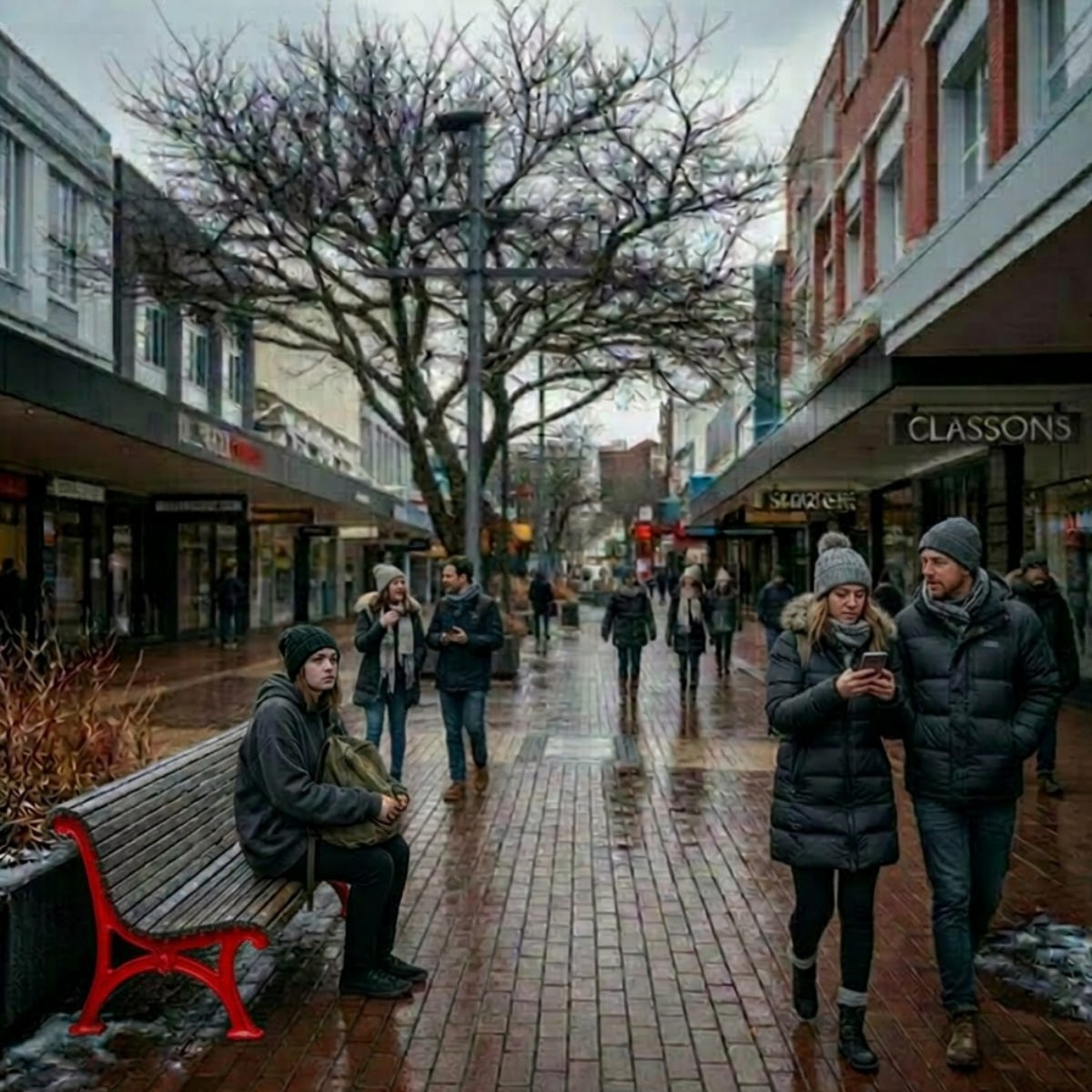
Image was created with Canva AI
Interestingly, so many agencies spoke up against the harm the move-on orders might cause. Police advised that this was not the best way to address poverty and homelessness, plainly saying they do not support criminalising rough sleeping and non-aggressive begging. Oranga Tamariki opposed applying the orders to young people, noting that existing models of care were more appropriate. Officials at Housing and Urban Development warned against the bill, the Ministry of Justice preferred the status quo. Corrections warned that it would likely need major investment in further prison infrastructure and the Treasury questioned the Government’s claim - that only six people a year would be jailed - calling it unlikely to withstand scrutiny. Several other agencies voiced their concerns about how the basic rights of young people and women sleeping rough would be violated by the move-on orders. Putting them at greater risk of harm, abuse, and exploitation if moved on from well-lit central spaces, especially at night.
The sharpest warning is about children. A Public Health Expert Briefing, published June 2026 by researchers from the universities of Otago and Waikato and Pūrangakura, sets out that the orders would allow children as young as fourteen to be detained, fined, or criminally charged for behaviours that are simply the face of homelessness - sleeping in a doorway, sitting with a sign asking for money. Almost half of all people experiencing homelessness in Aotearoa are under twenty-five – this statistic has Rachel’s face on it. Unfortunately, the state has not built the alternative: Oranga Tamariki has only 154 supported accommodation places for roughly 1,618 young people aging out of care each year, two-thirds of them Māori. There is nowhere to move on to. This is not a gap the researchers invented - in its Kāinga Kore report, the Waitangi Tribunal found the Crown had already breached the principles of active protection, equity, and good government, naming the lack of support for homeless rangatahi as an ongoing breach. This bill compounds it.
Amnesty International Aotearoa New Zealand has called for homes not handcuffs, warning that the powers are discriminatory and - given the ongoing effects of colonisation - will fall disproportionately on Māori. As their Executive Director Jacqui Dillon put it, “when a person is forced to move, particularly one who may have no other place to go, you remove their right to exist within the community.” They note the bitter irony that while England and Wales are repealing their Vagrancy Act, Aotearoa appears to be leaning back toward the Victorian era.
The Attorney-General and Housing Minister, Chris Bishop, filed a Section 7 report warning that key provisions of the bill are inconsistent with the New Zealand Bill of Rights Act - specifically the begging and rough-sleeping grounds. Community Housing Aotearoa, together with the Māori housing advocate Te Matapihi, formally opposed the move-on powers and called instead for housing-led action.
The bill has drawn unusually broad opposition, from opposition parties, almost every agency that is involved with the homeless, homelessness advocates, Māori organisations and various city councils.
The opposition to the bill is clear. The advice was given. The advice was not heeded.
Actually, the advice was not simply unheeded. It was overridden: the Justice Minister batted away his own officials’ warnings, saying the government stands by its approach.
Now, let’s consider what a move-on order actually does to her.
It does not produce a bed, an income, or a door she can lock. It produces a reason to disappear. A woman whose whole problem is that no one sees her is now, by law, deliberately moved on so she cannot be seen - further from the only safety she knows – the soup kitchen that knows her, the outreach worker who was building trust, deeper into the alleys where danger waits and caring eyes cannot follow. Move-on does not solve homelessness. It relocates it. And in relocating her, it strips an already invisible woman of the only protection she once had.
An Ubuntu-informed governance lens does not allow her to become invisible. It moves her back into the frame, where she belongs.
1. It designs with the person on the street; they get to define what help looks like.
2. It does not begin by asking whether the person can fit into the system, it focuses on simplifying paperwork, rigid criteria, and the processes that would make access to emergency housing overwhelming.
3. It asks whether it reaches the people who are unable to come to the service – understanding that people without shelter are often highly mobile, making it difficult to maintain contact with standard case management systems.
4. It assumes trauma or distrust before it assumes non-compliance – and so focusses on building relationship and gaining trust.
5. It asks, “what have we missed” and writes in revision at every stage – with a goal to continually close gaps it discovers.
In practice, that would mean fewer corridors of separate doors. Complete care loops that circle the whole person. And listening first before any decision is made. It would mean asking, at every stage: Who is not here? Why are they missing? Is the data we have capturing everyone? Whose story is being read as fault instead of harm?
It would mean measuring success, not by how many services exist, or how many are completing the application, but by how many people like her are no longer sleeping rough.
We still have people slipping through the gaps not because we don’t have support systems, but because the way we chose to shape the resources we offer is - application-based, siloed, conditional, counting the people who walk through the door and no one else. Rachel is not a gap between services to be tidied up. She is the most honest feedback the system has. If our doors do not reach her, it is not she who is failing the test. It is the test that needs to change.
But fortunately, her story isn’t over yet. This is not settled. The Summary Offences (Move-on Orders) Amendment bill is before the Justice Select Committee now, and submissions are open until 2 July 2026. If this article has moved you to action, that is the room you can still walk into - you can make a submission. This is your opportunity to speak for the people who are slowly becoming invisible. It is possible for YOU to give them a voice.
A note on ‘Rachel’: the young woman in this piece is not one person. She is a composite - every detail of her circumstances is true to lives I have sat with over twenty years of frontline practice, but she herself is an anonymised figure.
I have written her this way deliberately. The people I have spent my life serving are too often turned into a type, a risk score, a row in a dataset - flattened into someone the system can process. Drawing her as a composite lets me protect the real people behind her while keeping faith with the one thing this whole piece is about: that behind every number is a particular human being the system was supposed to see.
Denise Barlow-Byarugaba is a Human Systems specialist and the founder of The Room Institute. She practices through the lens of Ubuntu-informed AI governance - a framework that redesigns systems that make decisions about people, from policy to automated decisions, with the communities that carry the cost of our failures. She draws on almost 30 years in community development, walking alongside Māori, Pasifika, and CALD communities across Aotearoa and East Africa. She has worked on both sides of the glass: the frontline, where she has seen what poorly designed systems do to people, and inside the build, where she has seen how they are made. She partners with government agencies and NGOs to redesign those systems so that the vulnerable are protected, as welfare policies and emerging technologies land in real lives.